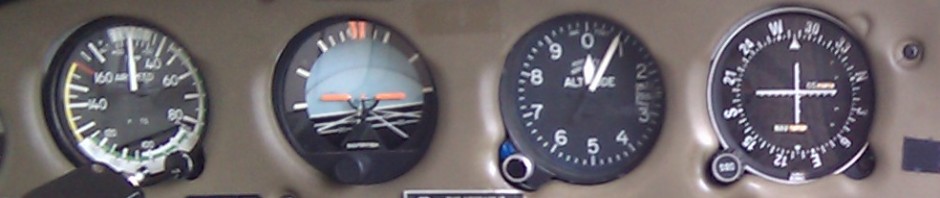
Yesterday was the 9th anniversary of the day I passed my flight test and got my private pilot’s license (PPL). It was also, coincidentally, the longest straight-line distance I’ve flown in a day, 930 nautical miles (1,722 km) from Winnipeg to Ottawa. When a fellow aviator made a comment about Ground School on Google+, it got me thinking about how stunningly different flight training was from actually flying after I got my PPL. Here’s my comment, based on my first 9 years and 860 hours …
I’ve met new pilots whose instructors have taught them that it’s “cheating” to use a GPS. Is it cheating to use the VOR receiver, then? What about the printed charts? I guess the trim wheel is cheating too, since it makes it too easy to hold the yoke. Pilotage and dead-reckoning are useful skills to learn and practice, but they should be maybe 10% of the navigation training for your PPL, not 90%. The 1930s were a long time ago.
You’ll always use a GPS for long cross-country flights, with or without backup from land-based navaids and your own pilotage (I still look out the window and mark my position and time on the VNC when I cross landmarks – it’s good to stay aware in multiple ways). You’ll use your GPS more than anything else in the plane besides the yoke, rudder pedals, and throttle; in fact, you’ll use it more than the throttle, which you might not touch for 4 hours on a long flight.
You’ll never sit down before a trip and put together a navigation log with the winds and groundspeed for every leg — that’s just a waste of time with modern flight-planning websites and applications. Instead, you’ll spend all that time worrying about your fuel stops: How late will the attendant be there (or will the self-serve pump actually work)? Are you cutting it too close for time/distance? If they’re fogged in, how far is the next one? Are there landing, handling, or ramp fees? Will the washroom be locked after 5:00? Can you get a taxi into town? Is there cell phone reception? How will you close your flight plan? Is there anywhere to get food?
You will learn to respect the weather like a medieval monk fearfully respected his God, and after many painful experiences over a few years, you’ll know more about weather than any ground school ever tried to teach you. At first, you learn to read what’s in the forecasts (GFAs, FDs, TAFs, etc.); eventually, however, you learn to read what’s not in the forecasts (“that much moisture north of Lake Superior means Marathon might be fogged in, even though it’s not forecast”; “I bet there will be a break in the storm line over the cool water of Lake Nippissing”; “I don’t trust the storms not to build up earlier with the winds blowing that way over the hills”), and that’s when you start flying well.
 Land and Hold Short
I didn’t get taught a single iota about the GPS in my ground school. However, the attitude (at least in my personal experience) wasn’t that it was cheating.
I agree with the fact that you need to know pilotage and dead reckoning. These are important skills you need to know IN ADDITION to knowing how to operate a GPS. I had to learn how to use it on my own (and I still mainly just do “direct to”).
One resource that I use that I discovered on my own are the weather manuals that Nav Canada publish about each region in Canada. They are invaluable when it comes to interpreting METARs and TAFs. (http://www.navcanada.ca/NavCanada.asp?Content=contentdefinitionfiles%5Cpublications%5Clak%5Cdefault.xml)
Great post, I completely agree.Try to describe a beautiful sunset with sweet calm air, or the fear after heavy chop bangs your head on the canopy. Like looking at the world in shades of gray, the training that gets you the certificate lacks the full brilliant color of real world flight. Thanks for sharing.
Blake – yes, the local-knowledge weather manuals are great. I had a disappointing experience on the phone with a Nav Canada briefer a few days ago, when I was trying to talk about the risk of fog on the north shore of Lake Superior, and the briefer clearly hadn’t read those manuals (or didn’t want to talk about them). Usually, the briefers at London FIC are the best out there for weather knowledge, so I’ll treat that guy just as the exception that proves the rule.
RE: GPS
While I don’t see GPS as cheating, I do see that the other facets of learning
the basics of navigation well, and practicing them to keep your skills
up to par, are essential to safe flight.
Here is why.
First, electronic devices do fail.
Usually, at the wrong time.
When you are relying on a gps to navigate, in an area where you are
not familiar, the loss of the GPS can cause some very quick and
very disturbing consequences.
Now, this will vary somewhat depending on your level of experience,
but lets say that you are a fairly low time pilot, weather is not bad
but not really good either.
If you are anythng like me, who finally learned to navigate to get
an instrument rating, being lost, at night, or in the day, in poor
visibility can cause a high level of anxiety………almost instantly.
A case of the “dry mouth” for a newbie pilot can be very disconcerting
and if, because you were relying on your GPS, because it is so
accurate, you really don’t need to pay much attention to detail,
that you plan your VFR fuel reserves pretty close……
Suddenly, you have a dead GPS. (Did you charge your backup
set of batteries……all 3 backup sets before you left?……or forget
them in the car with the other junk you didn’t want in the plane)
If this happens when you are not over familiar landmarks,
(which is most of the time between checkpoints), and your
maps are not neatly folded where you can get your hands on
them, perhaps tucked in the side of your flight bag in the
back seat……..)
And your ability to hold a heading is something less than perfect,
as it is for many pilots………. Can you consistently hold a heading
within 1 degree? 5 degrees? 10 degrees? 20 degrees?………and
while you are reaching for the map the heading drifts even more.
A lot of things can go wrong very quickly, while you are trying to
figure out what to do next, where you are, where you want to go….
and a 45 minute fuel reserve (or 30 minute one ) can get consumed
a lot faster than it does when there is no reason to sweat and
the GPS is working………at night the anxiety problem can be made
rough when the auto rough on your engine kicks in, and if it is
at night, over one of the lakes, where you might be out of sight of
land, auto rough is even rougher.
Good navigation habits take practice to build and make into a third
nature.
GPS and glass panels provide a lot of information and contribute,
over time, to sloppy flying habits
Yes they are nice. Neat toys.
But really, the only instrument that works consistently in
an airplane is the compass.
Knowing how to use it and being able to know it’s quirks so
you can turn to headings precisely as if it were a Directional
Gyro, is a worthwhile skill.
Gyros fail…….
Airspeed indicators fail……..
Altimeters fail…….
Vertical speed indicators fail……
Batteries fail…….
Radios fail…….
Autopilots fail…..
Landing gear motors fail……….
Keeping a paper flight log with up to date, hand
written position reports and a current chart with times
passing each checkpoint written in black ink is
a worthwhile habit to build. It takes practice.
Relying on the GPS, as a beginning pilot is a
dangerous crutch. Yes it helps develop
situational awareness.
But, it also pulls out the laziness in all of us.
Last……..when things are going wrong……
the anxiety factor (dry mouth experience) can,
almost instantly, can and will make the accurate
pushing of various (correct) buttons on a GPS or a
Glass Panel, more difficult.
With a mistake having much more serious consequences.
Regarding the consequences……….
A recent study by the NTSB said that aircraft
having glass cockpits had a considerably higher
FATALITY RATE.
Why?
This is only an educated guess, but it is my
2 cents worth.
Early in a flying career……..usually the first
50 years qulify as “early” normal problems
can cause anxiety.
Where navigation is concerned, situational
uncertainty will create ansiety quickly.
This makes it more difficult to sort out the
right button to push…….and if the thing
with the buttons is dead, and you didn’t
do the other things to stay on top,
things will quickly go from bad to worse.
The comfort that comes from having the
latest and greatest can be deceptive
and people who program these things
do make errors…..as recently was
apparent with the Airbus over the
Atlantic.
This creates complacency, the willingness
to tackle more difficult weather, and
the liklihood that whne you hit something
it will be hard enough to break the airplaner……
with you in it.
As a case in point………….
I had a friend, an instrument rated lawyer,
I fly with.
He always carries 2 GPS devices.
I carry my paper and pencil, chart and
stopwatch…….
We had an electrical failure which took
out all of the plane navigational devices.
He picked up GPS #1 which promptly died because
the batteries had run down during the flight
He picked up GPS #2 which would not turn
on because he had not charged the batteries
recently.
The other batteries were dead.
He says that any pilot who doesn’t use a GPS
is negligent.
We maintained a compass heading until
we broke out then flew the remainder
VFR using my ETA’S and paper charts.
What would Christopher Columbus do?
Moral: We train for the worst case and
hope it never happens.
Sometimes it does happen………sooner
than you wish…….
Fred: I agree with you completely about the importance of knowing alternative ways to navigate, and practising them regularly. My issue is that during PPL training, schools neglect to teach student pilots how to use GPS nav properly, which is the one they’ll be using 99% of the time in real life; as a result, we’re licensing pilots who are missing a big chunk of training, and putting those pilots unnecessarily in danger.
That’s not to say that they shouldn’t also learn pilotage, dead-reckoning, and radio navigation, but they need to know how to fly with tools invented after 1950 as well, and our flight-training system has done a horrible job at that.
Wish to finish ma ppl can sm1 help me out
+27 848511272
learn to write in proper English first would be a start…..
I’m a pilot aspirant.I’m planning to take private pilot training.But I’m getting more reviews the PPL alone won’t get me a pilot job even as corporate pilot.How can I build my flying hours after getting the PPL.Pilots with a great experience could help me with their valuable answers.Thanks in advance
I’ve seen two general approaches to building hours after the PPL:
1. Go straight to your CPL and instructor rating, then try to find an instructor job and build hours that way.
2. Stay with PPL for a while, buy a share in a partnership for a cheap plane like a Cherokee 140, and use it for your CPL, instrument rating, and general time building.
Personally, I’m happy to stick with my PPL. I use my plane to fly myself on business trips, but I have no plans to become a professional pilot (and at my age, it would be a pretty short career anyway).
Thanks for explaining that getting a private pilot license means we’ll learn to respect the weather, and even learn how to read what’s not in the forecast. My husband is interested in taking flying lessons soon because he’s always wanted to get a private pilot’s license. I’m glad I read your article because you gave me a good idea of what to expect after he completes his lessons!
Hi, Daphne! So glad it was helpful after all these years. Once he’s started, you might be interested in taking a short “co-pilot” course that will teach you just the basics of handling a plane and landing it in an emergency. You’ll almost certainly never have a serious emergency when you’re flying with your spouse, but the course would help you understand what’s going on when you fly with your spouse, and even help out a bit.
Who knows? Maybe you’ll like it so much you’ll want to go on and become a licensed pilot, too.