Hiatus and Return

I took a six month break from flying — basically, work, a long wait for new fuel caps at my annual, and a family vacation in London (UK) got in the way. I also managed to prove the third rule of aviation (after the large-fortune and old-bold pilots ones):

You can have enough time to fly, or enough money to fly, but not both.

Changes in work

Consulting work has been wonderful crazy busy for me and pretty-much every other consultant I know, whether in IT, business, aid work, development, or what-have-you. Canada barely got brushed by the recession that devastated the US in 2008-09 (with record-high property prices in most of our big cities, it may be that our bubble just hasn’t burst yet). The problem is that my customers are mostly in Canada and the UK now — the US economy isn’t so great, remember — so I don’t have work excuses to fly down to Boston, NYC, Washington, etc. like I used to.

Recency Lost

I’ve never taken such a long break before. After six months away from flying, bad things start to happen:

  • You can’t fly IFR, because you have to have done six hours real/simulated IMC and six approaches within the last six months (the infamous 6-6-6).
  • You can’t carry passengers at night, because you have to have done five takeoffs and landings at night within the last six months.
  • You can’t carry passengers during the day, even other pilots, because you have to have done five takeoffs and landings (any time) within the last six months.

Recency Regained (part 1)

So now it’s a matter of crawling my way out of the hole, milestone by milestone, until I can get back to my regular IFR/cross-country kind of flying. I started by calling my flying buddy Mike Hopkinson and asking for an intervention, and he complied by texting me last Saturday to remind me to get to the @#$% airport and then meeting me after his shift on dispatch. I uncovered the plane, made some stupid mistakes trying to start it (yes, it does help to check the fuel cutoff), recharged the battery that I drained, then did my normal post-maintenance checks:

  • Long, thorough preflight, including control movements.
  • Confirm that the engine compartment is clean (I even took a picture for before/after comparison).
  • Do a 5-minute lean ground-runup, and watch for anomalies.
  • Do a high-speed taxi down the runway to check what happens as the controls become effective.
  • Shut down and search for stains, leaks, cracks, or anything else that shouts DON’T FLY!
  • Start up again and fly circuits, always within gliding distance of the runway.
  • Shut down and repeat the stain/leak/crack checks.

The plane passed with flying colours (so to speak — my paint scheme is drab), and I managed five touch-and-go landings in a crisp cross-wind, progressing from “what-the-hell-was-that?” on the first to “now I’ll gently lower the nosewheel exactly on the centreline” on the fifth. It turns out the the rules make sense — 5 really is the magic number, and now I was legal to carry passengers in day VFR.

Victory lap to Toronto and back

As soon as I was done that and mentioned it on Facebook, my older daughter asked me if I could pick her up in Toronto and bring her home for a break from her studies at U of T. It grated to be a VFR-only pilot, but the weather on Friday co-operated beautifully, so I managed to get 4 hours of proper cross-country flight time (3.6 hours air time) on a beautiful spring day. I was ridiculously nervous beforehand, but on the day of, my flying and radio work through the busy Ottawa and Toronto airspace was fine, and the flight was as boring and uneventful as I want all my flights to be (my rule is that the only excitement in flying should come from the scenery outside the window). No new milestones from that flight, but I feel confident now to start back into the night and IFR work — 2 more milestones to go.

Posted in General | Tagged , , , , | 3 Comments

Calls for violence

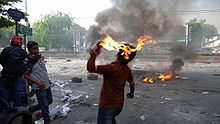
Protesters throwing molotov cocktails in Thailand.At OurAirports, an anonymous visitor has left the same comment for six different Vietnamese airports (including an air force base), encouraging a Libyan-style uprising in Vietnam (the comments should be gone by the time you read this, for reasons that will become clear below). According to Google translate, each comment begins something like this:

Other ways to protest that a person can do.

Libyan people using violence to overcome violence, ONLY NEW VIOLENCE AGAINST THE VIOLENCE.

Please all the people of Vietnam Hero follow Libyan people:

Gasoline burn all government buildings, the gas plants, the tank cars carrying fuel, the homes of Communist Party members Hunting Dogs.

Each comment then goes on to provide detailed instructions with different ways of making and using Molotov cocktails. My approach to comment moderation on OurAirports is fairly permissive — I’m happy to leave in comments with strong language, political views, or even scammers trying to defend themselves (it’s fun to see other commenters take them down). I will not, however, allow comments encouraging violence, and even more importantly, I won’t allow comments that include weapon-making instructions.

In a wonderful bit of unintended irony, each comment ends like this:

The U.S. government declared, would send U.S. troops to guard the people’s protests, the people in countries with rebel demands to overthrow dictatorships.

The United States — saviour of the Vietnamese people?

Posted in General | Tagged , , , | 7 Comments

6th anniversary of Land and Hold Short

I started this blog on 1 October 2004, with a typical welcome-to-my-blog posting. Thanks to everyone who’s been reading over the past six years.

Posted in General | 4 Comments

8 years as a licensed pilot

Eight years ago today, on 29 August 2002, I passed my flight test and earned my Private Pilot License — Aeroplane (PPL). I had 56.9 hours in my logbook (14.1 solo), and took the flight test late in the afternoon in rented Cessna 172P C-GPMR after the examiner, Bill Gadzos, finished his shift in the Ottawa Airport control tower.

Whee! I’m free!

Over the next month, I took with a few short flights in rented C-172s to celebrate my newly-won independence: to Kingston Airport to fly my parents around on 6 September, to Morrisburg Airport on 13 September, to Smiths Falls Airport on 18 September, to Peterborough Airport on 25 September, and finally, with my kids and my spouse’s cousin Andrea, over Arnprior Airport and back on 29 September.

But is it useful?

After only a month, however, the excitement of flying same-day trips within an hour of Ottawa in a rented plane was wearing very thin. I wanted flying to be useful, and to get to that point, I needed three more things:

  1. A night rating, so that I wasn’t restricted to daylight flying
  2. An instrument rating, so that I wouldn’t be grounded for days in bad weather
  3. My own plane (or a share in one), so that I could go on real trips for business or family vacations

Student again … and owner

So barely a month after earning my PPL, I had my instructor, Alain Mussely, back in the right seat working with me on my night and IFR ratings. I went airplane shopping at the at the Buttonville Airport in November 2002 and decided to buy a 1979 Piper Warrior II (C-FBJO) — a low-maintenance, fuel-efficient plane that can cruise at 125 knots true airspeed for six hours (no reserve) with a 665 lb load. The plane arrived in Ottawa on 4 December 2002 for an extensive pre-purchase inspection, then I put it into the shop to have a four-place intercom installed over Christmas.

I earned my night rating in February 2003, and my instrument rating in July 2003, and then I had everything I needed. A couple of long trips before the instrument rating had convinced me of its value: I got stuck overnight at North Bay Airport because of bad weather on a flight back from Sault Ste. Marie in May 2003, and had to race out of Caldwell Airport near New York City in June 2003 in the wee hours of the night to escape ahead of 3-4 days of bad weather.

Finished

On 28 July 2003, I took my family and dog up for our first cross-country IFR flight. It was gloomy on the ground under a low overcast, and it was strange for my family inside the clouds when everything outside the windows went white, but then suddenly we burst into brilliant sunshine and blue skies. 11 months after earning my PPL, I finally had everything I needed to make flying useful. I have 750 hours’ more experience now, but I still have the same license, the same plane, and the same ratings.

Posted in General | 2 Comments

Search and Rescue near Algonquin Park

Emergency Locator Transmitter

A typical ELT.

I had an unusual experience this morning flying home from Sault Ste. Marie to Ottawa with my dog, Paisley. Three separate high-altitude jets heard an ELT signal at a point along my route about 20 miles south of North Bay.

The most common types of ELTs will start sending a signal automatically when they experience high G-forces (such as when an aircraft has made a forced landing or crashed), but most often, an ELT signal just means that a boat has bumped against a floatplane, someone forgot to turn off an ELT in the back of a courier truck being shipped back for a battery changed, etc. etc. It used to be that satellites monitored the emergency frequency 121.5 MHz, but they don’t do so any more (they’ve switched to the new 406 MHz frequency), so it’s up to us pilots to listen and report.

Joining the search

There was already a plane or helicopter with the callsign “Rescue 333″ doing a lower-level visual and ELT search. It also happened, however, that Toronto Centre was already talking with two small planes at lower altitudes who would both be crossing the location where the signal was received: me from west to east, and a Cessna 172 from south to north. Centre enlisted both of us to widen the radio-search area by tuning in 121.5 MHz on our second radios and listening for any signal as we passed through. Every 3-5 minutes, I turned off the squelch on my radio: that creates horrendous static, but it also lets me hear very faint signals.

None of us, including the search aircraft and other high-altitude airliners, heard anything more. I looked as carefully as I could, but from 9,500 ft in a low-wing aircraft it’s hard to see much detail, and I didn’t want to go lower and interfere with the Rescue aircraft’s search patterns.

Ping!

About 20 minutes later, over Algonquin Park, however, I did suddenly hear one very brief ELT wave (the part that sounds like a sheet of metal pinging), as if someone had switched an ELT on to test it then turned it off a second later. It was 8 minutes after the hour. All ELT testing is supposed to take place during the first five minutes of each hour, but I suspect that some floatplane pilot somewhere in the park just had a slow watch. Still, I reported what I heard to Centre, and they passed it on to the Rescue plane.

How to help

The odds are very high that this was a false alarm — most search and rescue calls are — but it was still sobering to think of a brother or sister pilot down there somewhere under the tree canopy, in desperate need of help. If you’re a pilot with two radios, I strongly suggest that you keep the second tuned to 121.5 MHz whenever you don’t need it to get weather, etc. — some day you might actually make a difference.

Posted in General | Tagged | Leave a comment

The #flightlog Twitter hashtag

I’ve used the hashtag #flightlog to post information about my last two flights to Twitter:

CYRO-CYAM VFR, 4.4 hours flight time (4.2 air time) PIC #flightlog

CYTZ-CYRO IFR 1.8 PIC in a PA-28-161 #flightlog

No one is using this hashtag for anything else, and it would make it easy for pilots to find other pilots on Twitter who’ve flown the same routes or used the same airports. So far, of course, I’m the only pilot to find.

Posted in General | Tagged , | 1 Comment

Why checkpoints matter

Let’s say that you’re going on a 300 nm (550 km) flight — a typical distance for a cross-country trip in a small plane — VFR, without radar coverage.  You file a flight plan, take off on time, but don’t arrive at your destination.  A couple of hours after your planned arrival time, once flight services has completed a few phone calls (your destination airport, your cell phone, your emergency contact) and confirmed that you haven’t landed safely and forgotten to close your flight plan, a formal search begins.

Where do they look?

Point A to Point B

Let’s say that you filed your flight plan from Point A to Point B and that there are no obvious barriers (mountains, large bodies of water, restricted airspace).  I’m not sure exactly how SAR works, but let’s assume that they’ll search within a 5 nm radius of each airport, and along your route of flight from those circles, allowing for a 10° drift in either direction.  The search area appears in grey below (not to scale):

Point A to Point B search area.

For a 300 nm flight, using my very rusty high school geometry skills, I calculate the search area to be nearly 9,500 nm²!  That’s a lot of forest to search for a little plane with an unconscious pilot strapped into the front seat.

Point A to Point B (via Point C)

Fortunately, we can improve our chances quite a bit, simply by providing a checkpoint halfway through the flight:

Point A to Point B via Point C search area.

Now that Search and Rescue knows that you intended to fly via Point C (represented by the yellow triangle), rather than, say, flying to the north for better scenery, or to the south to buzz your buddy’s cottage, they can anchor their drift lines at an additional point, cutting out a lot of search area (I’m still allowing a 5 nm circle of ambiguity around the checkpoint).  I calculate that the search area is now reduced from nearly 9,500 nm² to just under 5,500 nm², a reduction of over 40% simply by adding one checkpoint in the flight plan.

Point C to Point B

But wait, there’s more!  Let’s say that, when you were over Point C (your midway checkpoint), you actually made a call to flight services and gave a position report.  Now there’s no need to search anything before Point C, because they know you passed it before you made your forced landing:

Search area after making a radio call over Point C.

You’ve reduced the search area from the original 9,500 nm² down to about 2,800 nm² — still a lot, but I’d bet more on your chances now.  Simply choosing a checkpoint, and making a radio call over it, can make a huge difference.

Caveats, etc.

Flight following is an even better option, since ATC will know much more precisely where you disappeared from the radar.  Unfortunately, flight following at lower altitudes is available only in highly populated areas.  In Canada,  below 10,000 ft you’re beyond radar coverage for much of the southern area of the country, not to mention the vast north.  Even in the US, radar coverage can be spotty — I’ve fallen below radar at 7,000 ft when flying IFR in both Maine and New Hampshire, for example, reverting to non-radar reporting procedures.

A checkpoint makes sense only if you can report over it, which means that you need to be able to reach flight services, which is non-trivial at low altitudes away from populated areas.  I plan my VFR flights with checkpoints that I know will be in range of an RCO or DRCO; if that doesn’t work, you can always try relaying your position report through another aircraft (air-to-air range is much further than air-to-ground).

Another interesting option for people who fly a lot in remote areas is the Spot personal messenger (site), which updates your position continuously via GPS and satellite and displays it on a web site. I haven’t tried it yet, but the price looks reasonable. It would be critical to mention the Spot in the remarks for your VFR flight plan, so that SAR would know to go to the site and check your flight path.

Posted in General | Tagged , , | 4 Comments